
Clarifier Plate Packs for Industrial Wastewater
Met-Chem Lamella & Inclined Clarifier Plate Packs
Met-Chem manufactures clarifier plate packs for industrial wastewater treatment systems, including new lamella clarifiers, inclined plate clarifiers, and replacement plate packs for existing industrial clarification equipment.
The plate pack is one of the most important components of an inclined plate clarifier. Multiple parallel settling plates create a large effective settling area within a relatively compact tank.
As wastewater moves upward between the plates, suspended solids settle onto the plate surfaces. The solids then move downward into the clarifier sludge collection area while clarified water continues toward the effluent.
Met-Chem can provide plate packs for new clarifiers as well as replacement clarifier plate packs manufactured to fit existing industrial clarification systems.
Learn More
For replacement applications, provide Met-Chem with the existing plate pack dimensions, photographs, wastewater characteristics, operating temperature, and clarifier flow rate.

What Is a Clarifier Plate Pack?
A clarifier plate pack is an assembly of multiple parallel inclined settling plates installed inside a lamella or inclined plate clarifier.
The individual plates are arranged at a consistent angle and spacing.
Together, they create numerous settling channels through which wastewater flows.
The purpose of the plate pack is to reduce the distance suspended particles must travel before reaching a settling surface.
Instead of settling several feet to the bottom of an empty tank, a suspended particle may only need to travel the relatively short distance between adjacent plates.
Once particles contact a plate, they accumulate with other solids and move downward along the inclined surface.
This is what allows an inclined plate clarifier to provide substantial settling capacity within a compact footprint.
How Do Clarifier Plate Packs Work?
Inside an operating clarifier, water and solids generally move in opposite directions.
Water moves upward.
Solids move downward.
Chemically treated wastewater enters below the plate section and flows upward through the channels between the plates.
Suspended particles settle toward the inclined plate surfaces.
Once particles reach a plate, they combine with other settled material and form a heavier layer of sludge.
Gravity moves this material downward along the inclined surface.
The sludge eventually leaves the bottom of the plate pack and enters the clarifier sludge cone.
Clarified water continues upward and exits the clarifier.
A properly designed plate pack therefore needs to accomplish three things:
- Provide sufficient projected settling area
- Allow relatively uniform water flow
- Allow settled solids to move downward without excessive accumulation
Why Use Inclined Clarifier Plates?
Inclined plates allow a large amount of settling area to be installed within a relatively small clarifier.
Consider a conventional empty settling tank.
Its gravity separation capability is largely related to the horizontal settling area available in the tank.
An inclined plate clarifier places numerous additional settling surfaces inside that same general footprint.
Each plate contributes projected settling area.
A complete plate pack can therefore provide hundreds or even thousands of square feet of effective settling area depending on the size and configuration.
This is one of the primary reasons lamella and inclined plate clarifiers can provide high settling capacity without requiring extremely large settling basins.
60-Degree Clarifier Plates
Met-Chem commonly uses clarifier plates installed at approximately 60 degrees from horizontal.
Plate angle affects both settling area and sludge movement.
A clarifier plate must provide a surface for suspended particles to settle onto, but the collected solids also need to leave that surface.
At approximately 60 degrees, gravity helps accumulated sludge move downward along the plate.
If the plate angle is too shallow, some industrial sludges may be more likely to remain on the plate surface.
Met-Chem therefore considers both projected settling area and reliable sludge movement when selecting the plate configuration.
Clarifier Plate Spacing
The distance between adjacent settling plates is an important design consideration.
Installing plates extremely close together can increase the theoretical amount of settling area that fits inside a given space.
However, more theoretical area is not necessarily better.
The plate channels must remain large enough to allow:
- Wastewater flow
- Floc movement
- Settled sludge movement
- Inspection
- Cleaning
This is particularly important for industrial wastewater.
Industrial clarification systems may handle bulky or sticky solids including:
- Aluminum hydroxide
- Iron hydroxide
- Metal hydroxide sludge
- Paint solids
- Mineral solids
- Machining solids
- Chemical precipitates
- Other industrial suspended solids
Plate spacing should therefore be selected around the wastewater and solids characteristics rather than simply trying to fit the maximum number of plates into the tank.
A plate pack is only useful if wastewater and sludge can reliably move through it.
Projected Settling Area of Clarifier Plates
The physical surface area of an inclined plate is different from its horizontal projected settling area.
A simplified calculation is:
Projected Area = Plate Length × Plate Width × cos(θ)
Where:
θ = plate angle from horizontal
For a 60-degree plate:
cos(60°) = 0.50
For example, assume a plate measures:
8 feet long × 4 feet wide
Physical plate area:
8 × 4 = 32 ft²
Projected settling area at 60 degrees:
32 × 0.50 = 16 ft²
If a plate pack contains 40 comparable effective settling plates:
40 × 16 = 640 ft²
This is how a relatively compact plate pack can provide a large amount of projected settling area.
However, projected plate area should not be used as the only criterion for clarifier sizing.
Flow, settling characteristics, plate spacing, hydraulic distribution, retention time, solids loading, and sludge removal must also be considered.
Clarifier Plate Pack Surface Loading
Wastewater flow can be compared with the effective projected plate area using:
Surface Loading Rate = Flow ÷ Effective Settling Area
or:
SLR = Q ÷ A
Where:
Q = wastewater flow
A = effective projected settling area
For example:
If a clarifier operates at:
120 GPM
and provides:
600 ft² of projected settling area
then:
120 ÷ 600 = 0.20 GPM/ft²
The appropriate design loading depends on the wastewater and solids being treated.
This is why Met-Chem recommends evaluating the complete clarification process rather than selecting a plate pack based solely on square footage.
More Clarifier Plates Are Not Always Better
A common assumption is that adding more plates automatically improves a clarifier.
That is not necessarily true.
Adding more plates may increase theoretical settling area, but it can also reduce the spacing between the plates.
If the plate channels become too narrow for the solids being treated, the system may experience:
- Solids accumulation
- Restricted flow
- Uneven hydraulic loading
- Plugged plate channels
- Increased maintenance
- Reduced effective settling area
The objective is therefore not to install the greatest possible number of plates.
The objective is to provide the appropriate plate area and spacing for the wastewater application.
Clarifier Plate Pack Materials
Material selection depends on the wastewater chemistry, temperature, structural requirements, and operating environment.
Met-Chem commonly supplies PVC clarifier plate packs for industrial wastewater applications.
PVC can provide:
- Corrosion resistance
- Chemical resistance
- Relatively low weight
- Smooth settling surfaces
- Long service life in appropriate applications
Alternative materials can be considered when wastewater chemistry or operating temperature requires a different solution.
When replacing an existing plate pack, Met-Chem should be provided with information about the wastewater chemistry and operating temperature so the appropriate material can be evaluated.

Replacement Clarifier Plate Packs
The clarifier tank itself may remain structurally serviceable long after the original settling plates need replacement.
Plate packs can become:
- Damaged
- Brittle
- Warped
- Cracked
- Chemically attacked
- Heavily scaled
- Permanently fouled
- Structurally unstable
In these situations, replacing the plate packs may restore clarification performance without requiring replacement of the entire clarifier.
Met-Chem manufactures replacement inclined plate packs for existing industrial clarifiers.
The replacement pack can be designed around the existing tank dimensions and wastewater application.
What Information Is Needed for a Replacement Plate Pack?
If you need replacement clarifier plates, the original equipment drawings are helpful but are not always necessary.
Met-Chem can begin an evaluation using information from the existing clarifier.
Provide:
- Plate pack length
- Plate pack width
- Plate pack height
- Individual plate length
- Individual plate width
- Approximate plate spacing
- Plate angle
- Existing plate material
- Clarifier flow rate
- Wastewater chemistry
- Operating temperature
- Photographs of the plate pack
- Photographs of the clarifier
- Available drawings
If the original plate pack has already been removed, measurements of the support area inside the clarifier can also be useful.
Photographs with a tape measure visible are particularly helpful when evaluating replacement plate packs.
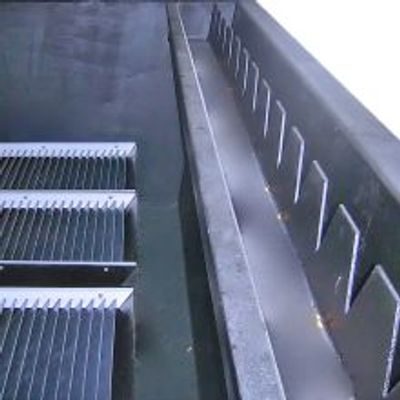
Measuring an Existing Clarifier Plate Pack
Accurate measurements help ensure the replacement assembly fits the existing tank.
Whenever possible, measure:
Overall Pack Width
Measure from one side of the complete plate assembly to the other.
Overall Pack Length
Measure the complete horizontal length occupied by the pack.
Overall Pack Height
Measure from the bottom to the top of the plate assembly.
Individual Plate Dimensions
Measure the width and length of an accessible plate.
Plate Spacing
Measure the clear distance between adjacent plates.
Plate Angle
Most industrial lamella systems use steeply inclined plates, but the existing angle should still be verified.
Support Locations
Photograph and measure the structural members that support the plate pack.
Providing these measurements allows Met-Chem to evaluate how a replacement pack can be installed in the existing clarifier.
Replacement options
A facility does not necessarily need to replace an entire clarifier because the plate packs have reached the end of their useful life.
If the existing tank, sludge cone, piping, and structural components remain serviceable, a replacement plate pack may be a practical option.
Met-Chem can evaluate replacement packs for many existing industrial inclined plate clarification systems based on the physical dimensions and process requirements of the equipment.
The important factors are not the name on the original equipment.
They are:
- Available space
- Required settling area
- Plate angle
- Plate spacing
- Structural support
- Wastewater chemistry
- Flow
- Solids characteristics
This allows the replacement plate pack to be engineered around the actual industrial wastewater application.
When Should Clarifier Plates Be Replaced?
Plate packs do not necessarily require replacement simply because they are old.
Replacement should be considered when the plates can no longer perform their intended function reliably.
Signs can include:
Broken or Cracked Plates
Physical damage can disrupt flow channels and settling surfaces.
Warped Plates
Warped plates can change channel spacing and create uneven hydraulic conditions.
Brittle Material
Aged or chemically attacked plastic can become fragile and difficult to service.
Permanent Fouling
Some deposits may become difficult or impossible to remove effectively.
Collapsed Plate Channels
Structural deformation can restrict water and sludge movement.
Missing Plates
Missing or displaced plates reduce the available settling area.
Chemical Damage
The existing plate material may not be compatible with the wastewater.
If the plate pack repeatedly requires excessive cleaning or no longer maintains open, uniform channels, replacement should be evaluated.
Cleaning Clarifier Plate Packs
Plate packs should be periodically inspected and cleaned when required.
The appropriate cleaning method depends on the plate material and the type of deposits present.
Operators should avoid damaging or displacing the plates during cleaning.
The objective is to restore open flow channels without harming the settling surfaces.
Frequent plate fouling can indicate a larger process issue such as:
- Excessive solids loading
- Poor sludge removal
- Incorrect chemical treatment
- Inappropriate plate spacing
- Hydraulic overloading
- Scale formation
Repeated cleaning should not be used as a substitute for correcting the underlying cause.
Sludge Removal Protects the Plate Packs
Plate pack performance is directly connected to sludge management.
Settled solids move down the plates and enter the sludge collection cone.
If sludge is not removed frequently enough, the sludge level can rise toward the bottom of the plate packs.
This can interfere with solids movement and eventually contribute to plate fouling.
Met-Chem can incorporate automatic sludge blowdown into industrial clarification systems.
Frequent removal of smaller quantities of sludge can help maintain available cone volume and protect the plate section from excessive solids accumulation.
Plate Packs for Metal Finishing Wastewater
Metal finishing wastewater is a common application for inclined plate clarification.
Chemical treatment can produce precipitated metal hydroxide solids that must be separated from the treated water.
These solids can be relatively light and bulky.
Proper plate spacing, flocculation, projected settling area, retention time, and sludge removal are therefore important.
Met-Chem plate packs can be incorporated into new metal finishing wastewater clarifiers or manufactured as replacement assemblies for existing systems.
Plate Packs for Aluminum Wastewater
Aluminum finishing and anodizing wastewater can generate significant quantities of aluminum hydroxide after pH adjustment and neutralization.
Aluminum hydroxide can create a relatively voluminous floc.
Attempting to maximize plate count by using extremely narrow channels may therefore be counterproductive.
The plate configuration should allow the aluminum hydroxide solids to settle and move downward without repeatedly restricting the plate channels.
Plate Packs for Other Industrial Wastewater
Clarifier plate packs can also be used for:
- Electroplating wastewater
- Manufacturing wastewater
- Chemical processing
- Mining and mineral processing
- Parts washing
- Surface finishing
- Machining wastewater
- Industrial process water
- Other applications containing settleable suspended solids
The appropriate configuration depends on the wastewater and solids being treated.
New Clarifier Plate Packs
Met-Chem manufactures plate packs as part of new lamella and inclined plate clarifiers.
For a new system, plate pack design can be coordinated with:
- Clarifier flow rate
- Projected settling area
- Tank dimensions
- Retention time
- Flocculation
- Sludge cone capacity
- Automatic sludge removal
- Wastewater chemistry
- Filter press sizing
This allows the entire clarification system to be engineered together rather than treating the plate pack as an isolated component.d.
Replacement Plate Pack vs. New Clarifier
Whether to replace the plate pack or the entire clarifier depends on the condition of the existing equipment.
Consider a Replacement Plate Pack When:
- The clarifier tank remains structurally sound
- The sludge cone is serviceable
- Existing hydraulics are acceptable
- The current clarifier has adequate capacity
- The primary problem is damaged or deteriorated plates
Consider a New Clarifier When:
- The existing unit is undersized
- Tank corrosion is significant
- Retention time is inadequate
- Hydraulic distribution is poor
- Sludge storage is inadequate
- Flow requirements have increased substantially
- The existing design repeatedly experiences solids carryover
Met-Chem can evaluate the application and help determine whether replacement plate packs or a complete new clarifier make more sense.
Clarifier Plate Pack Frequently Asked Questions
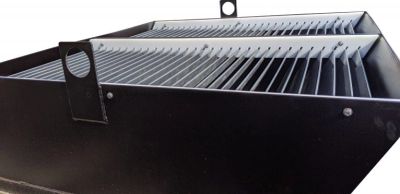
What is a clarifier plate pack?
A clarifier plate pack is an assembly of multiple parallel inclined settling plates installed inside a clarifier to increase effective settling area.
What are lamella plates?
Lamella plates are inclined settling surfaces used to reduce particle settling distance and increase the projected settling area within a clarifier.
What angle are clarifier plates installed at?
Met-Chem commonly uses clarifier plates installed at approximately 60 degrees from horizontal.
What material are clarifier plates made from?
Met-Chem commonly supplies PVC plate packs for industrial wastewater applications. Other materials can be considered based on wastewater chemistry and temperature.
How far apart should clarifier plates be?
Plate spacing depends on the wastewater and solids characteristics. The spacing must balance settling area with sufficient room for wastewater, floc, and sludge movement.
Can clarifier plate packs be replaced?
Yes. Plate packs can often be replaced without replacing the entire clarifier if the existing tank remains serviceable.
Do I need the original clarifier drawings?
Not necessarily. Drawings are helpful, but Met-Chem can begin evaluating a replacement plate pack using dimensions, photographs, wastewater information, and flow requirements.
How do I measure a replacement plate pack?
Measure the overall pack length, width and height, individual plate dimensions, plate spacing, angle, and structural support locations. Photographs showing a tape measure are also helpful.
Does more plate area always improve clarification?
No. Excessively tight plate spacing can restrict wastewater and sludge movement. Plate area, spacing, hydraulics, solids characteristics, and retention time must work together.
How do I know if I need new plates or a complete clarifier?
If the tank is structurally sound and adequately sized, replacement plates may be sufficient. If the clarifier is undersized, corroded, hydraulically poor, or lacks adequate retention time, replacing the complete clarifier may be more appropriate.