
Lamella Clarifier for Industrial Wastewater Treatment
Met-Chem Lamella Clarifiers
Met-Chem designs and manufactures lamella clarifiers for industrial wastewater treatment applications. Our inclined plate clarification systems provide a large effective settling area within a compact footprint while providing the retention time, sludge storage, and process control needed for industrial wastewater treatment.
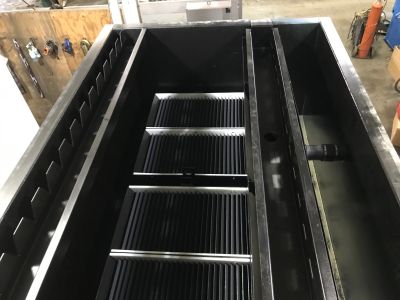
A lamella clarifier uses a series of inclined parallel plates to separate suspended solids from water through gravity settling. Instead of requiring particles to settle the full depth of a large tank, the inclined plates greatly reduce the distance solids must travel before reaching a settling surface.
Met-Chem lamella clarifiers can be supplied as standalone equipment or integrated into a complete industrial wastewater treatment system including pH adjustment, coagulation, flocculation, sludge handling, and filter press dewatering.
Met-Chem manufactures standard and custom lamella clarifiers for industrial wastewater applications.
Industrial Applications for Lamella Clarifiers
Metal Finishing
Wastewater from metal finishing processes can contain dissolved metals, suspended solids, cleaners, acids, alkalis, and other contaminants.
Chemical treatment followed by lamella clarification can remove precipitated metals and suspended solids.
Electroplating
Plating wastewater often requires pH adjustment and chemical precipitation before clarification.
The lamella clarifier separates the resulting metal-bearing sludge from the treated water.
Aluminum Finishing and Anodizing
Neutralization of aluminum-bearing wastewater can generate significant quantities of aluminum hydroxide solids.
A properly designed lamella clarifier can separate these solids following chemical treatment and flocculation.
Manufacturing
Parts washing, machining, fabrication, coating, and other manufacturing processes can generate wastewater containing settleable or chemically precipitated solids.
Mining and Mineral Processing
Lamella clarification can be used to separate suspended mineral solids and other settleable material from process wastewater.
Chemical Processing
Industrial chemical wastewater applications can use lamella clarification whenever treatment produces solids that can be separated by gravity settling.
Lamella Clarifier Sludge Removal
Lamella Clarifier and Filter Press System
Where Does the Clarifier Sludge Go?

Removing sludge is just as important as settling it.
As solids move down the inclined plates, they accumulate in the bottom cone of the clarifier.
If this sludge is allowed to build excessively, the sludge level can rise toward the plate packs and interfere with clarification.
Met-Chem therefore recommends establishing a regular sludge removal procedure.
For many applications, an automatic sludge blowdown system is preferable.
Instead of waiting for the cone to fill with a large volume of sludge, smaller quantities can be removed frequently.
This helps maintain available sludge storage volume and provides more consistent clarifier operation.
Where Does the Clarifier Sludge Go?
Lamella Clarifier and Filter Press System
Where Does the Clarifier Sludge Go?
Clarifier sludge still contains a significant amount of water.
For many industrial applications, the next step is sludge dewatering.
A common Met-Chem process is:
Lamella Clarifier → Sludge Holding/Thickening Tank → Filter Press
The sludge holding tank provides storage between clarifier blowdown cycles and filter press batches.
The filter press then applies pressure to remove additional water from the sludge and produce a substantially drier filter cake.
Filtrate from the filter press can often be returned to the beginning of the wastewater treatment system
Lamella Clarifier and Filter Press System
Lamella Clarifier and Filter Press System
Lamella Clarifier and Filter Press System
Lamella clarifiers and filter presses work particularly well together because they perform complementary functions.
The lamella clarifier is generally a continuous separation device.
The filter press is a batch dewatering device.
The clarifier continuously removes suspended solids from the wastewater stream and concentrates those solids into a smaller sludge stream.
The filter press periodically processes that concentrated sludge.
This arrangement allows an industrial wastewater system to continuously treat water while producing a dewatered filter cake for disposal.
Lamella Clarifier Plate Packs
Maintaining a Lamella Clarifier
Lamella Clarifier and Filter Press System
The plate pack is one of the most important components of the clarifier.
Met-Chem plate packs use multiple inclined parallel plates to create the settling area required for clarification.
Standard Met-Chem plate packs can include:
- 60-degree inclined plates
- PVC settling plates
- Structural outer frame
- Closely spaced parallel flow channels
- Lifting points for removal and maintenance
Alternative materials can be considered when required by wastewater chemistry or operating conditions.
Met-Chem also manufactures replacement lamella clarifier plate packs for industrial clarification equipment.
Automatic Sludge Blowdown
Maintaining a Lamella Clarifier
Maintaining a Lamella Clarifier
A Met-Chem lamella clarifier can be equipped with an automatic sludge blowdown system.
The system can periodically open the sludge discharge valve and activate the sludge pump.
The timing is adjusted according to the amount of solids generated by the wastewater treatment process.
Automatic blowdown can:
- Reduce operator involvement
- Prevent excessive sludge accumulation
- Maintain available cone volume
- Provide consistent sludge removal
- Reduce the chance of solids reaching the plate pack
- Improve overall system consistency
During startup, sludge production should be monitored so the blowdown frequency can be adjusted for the actual application.
Maintaining a Lamella Clarifier
Maintaining a Lamella Clarifier
Maintaining a Lamella Clarifier
Lamella clarifiers are relatively simple mechanical systems, but proper operation and maintenance are still important.
Operators should periodically inspect:
- Plate packs
- Effluent weirs
- Sludge cone
- Sludge discharge valves
- Sludge pumps
- Mixers
- Polymer system
- pH controls
- Floc formation
- Effluent clarity
The plate packs should remain open enough for wastewater and solids to move through the channels as designed.
Excessive solids accumulation should be investigated rather than simply allowed to continue.
Common Lamella Clarifier Problems
Benefits of a Met-Chem Lamella Clarifier
Benefits of a Met-Chem Lamella Clarifier
Cloudy Clarifier Effluent
Possible causes include:
- Poor pH control
- Insufficient chemical precipitation
- Incorrect coagulant dosage
- Incorrect polymer dosage
- Poor floc formation
- Excessive hydraulic flow
- Excessive solids loading
- Sludge accumulation
The first step should be determining whether the problem is chemical or hydraulic.
Solids Carrying Over the Weir
Solids carryover may indicate that the clarifier is overloaded, floc is not settling properly, or excessive sludge has accumulated in the bottom of the unit.
Solids Accumulating in the Plate Packs
Possible causes include poor sludge removal, excessive solids loading, inappropriate plate spacing, or solids that do not readily slide from the plate surfaces.
Excessive Sludge in the Cone
Increase sludge removal frequency rather than allowing the cone to remain full for extended periods.
Benefits of a Met-Chem Lamella Clarifier
Benefits of a Met-Chem Lamella Clarifier
Benefits of a Met-Chem Lamella Clarifier
A properly designed Met-Chem lamella clarification system can provide:
- Large effective settling area
- Compact footprint
- 60-degree inclined plate design
- Approximately 50–60 minute retention time
- Integrated flocculation
- Automatic sludge blowdown
- Multiple construction materials
- Standard and custom flow capacities
- Integration with Met-Chem filter presses
- Complete wastewater treatment system capability
Most importantly, Met-Chem can evaluate the entire treatment process rather than selecting the clarifier based solely on a theoretical flow rating.
Met-Chem Lamella Clarifier Manufacturer
Benefits of a Met-Chem Lamella Clarifier
Met-Chem Lamella Clarifier Manufacturer
Met-Chem designs and manufactures lamella clarifiers, inclined plate clarifiers, clarifier plate packs, filter presses, and complete industrial wastewater treatment systems.
Our goal is not simply to provide a tank with inclined plates.
The chemical treatment, flocculation, clarification, sludge removal, and dewatering processes must work together as a complete system.
If you are considering a new lamella clarifier, provide Met-Chem with as much information about your wastewater as possible, including:
- Average GPM
- Maximum GPM
- Hours of operation
- Wastewater source
- Suspended solids
- Dissolved contaminants
- Wastewater analysis
- Required discharge limits
- Existing chemical treatment
- Available floor space
Met-Chem can use this information to help determine the appropriate treatment process and clarifier configuration.
Contact Met-Chem for lamella clarifier sizing, equipment pricing, replacement plate packs, or a complete industrial wastewater treatment system.