
Inclined Plate Clarifier for Industrial Wastewater Treatment
Met-Chem Inclined Plate Clarifiers
Met-Chem designs and manufactures inclined plate clarifiers for industrial wastewater treatment applications. Our clarifiers use multiple parallel settling plates positioned at approximately 60 degrees to provide a large effective settling area within a compact footprint
An inclined plate clarifier separates suspended and chemically precipitated solids from wastewater using gravity. Instead of requiring solids to settle the entire depth of a conventional clarification tank, closely spaced inclined plates provide multiple settling surfaces throughout the clarifier.
This reduces the vertical distance suspended particles must travel before reaching a settling surface
Met-Chem inclined plate clarifiers can be supplied as standalone clarification equipment or as part of a complete industrial wastewater treatment system incorporating pH adjustment, coagulation, flocculation, sludge handling, and filter press dewatering.
Contact Us
Met-Chem manufactures standard and custom inclined plate clarifiers for industrial wastewater applications.
Industrial Applications for Inclined Plate Clarifiers
Metal Finishing Wastewater
pH adjustment and chemical precipitation can convert dissolved metals into suspended metal hydroxides.
Coagulation and flocculation increase particle size before the wastewater enters the inclined plate clarifier.
Electroplating Wastewater
Inclined plate clarification can separate precipitated metals and other suspended solids from chemically treated plating wastewater.
Aluminum Anodizing Wastewater
Neutralization can create substantial quantities of aluminum hydroxide solids.
Proper flocculation followed by inclined plate clarification can separate these solids from the treated wastewater.
Manufacturing Wastewater
Parts washing, machining, fabrication, finishing, coating, and other manufacturing operations can produce wastewater containing suspended or chemically precipitated solids.
Mining and Mineral Wastewater
Inclined plate clarification can be used to separate settleable mineral solids from process water.
Chemical Processing
Industrial processes that generate precipitated or suspended solids can incorporate inclined plate clarification as the gravity separation stage.
What Is an Inclined Plate Clarifier?
How Does an Inclined Plate Clarifier Work?
How Does an Inclined Plate Clarifier Work?
An inclined plate clarifier is a gravity separation device containing multiple parallel plates installed at an angle within a clarification tank.
The inclined plates increase the effective settling area available for separating suspended solids from water.
In a conventional settling tank, a suspended particle may need to travel several feet vertically before reaching the bottom of the tank.
An inclined plate clarifier places settling surfaces throughout the water column.
Instead of traveling several feet, a particle may only need to travel the relatively short distance between adjacent plates before reaching a settling surface.
Once solids reach the plate surface, they accumulate with other particles and move downward along the inclined plate.
The solids eventually fall into the sludge collection cone while clarified water continues upward through the plate pack.
This allows an inclined plate clarifier to achieve substantial settling capacity without requiring an extremely large tank footprint.
How Does an Inclined Plate Clarifier Work?
How Does an Inclined Plate Clarifier Work?
How Does an Inclined Plate Clarifier Work?
An inclined plate clarifier separates solids and water by creating two opposing movements within the plate section:
Clarified water moves upward.
Settled solids move downward.
Wastewater enters the clarifier below the inclined plate section and is distributed across the available plate area.
As the wastewater flows upward through the spaces between the plates, suspended particles settle toward the plate surfaces.
Once particles reach a plate, they begin accumulating with other solids.
The inclined surface then allows gravity to move these solids downward.
The accumulated sludge travels toward the bottom of the plate pack and ultimately falls into the clarifier sludge cone.
The clarified water continues upward, reaches the top of the clarifier, and exits across the effluent weirs.
This counter-current movement allows the plate pack to continuously separate solids from the upward-flowing wastewater.
Why Use Inclined Plates in a Clarifier?
How Does an Inclined Plate Clarifier Work?
Why Are Clarifier Plates Installed at 60 Degrees?
The primary purpose of the inclined plates is to create more effective settling area within less floor space.
Consider an empty rectangular tank.
Its effective gravity settling area is primarily associated with the horizontal surface area of the tank.
Now imagine installing dozens of parallel settling surfaces inside that same tank.
Each inclined plate contributes additional projected settling area.
The result is a clarification system that can provide substantially more effective settling area than an empty tank occupying a similar footprint.
This is particularly valuable in industrial facilities where floor space is limited.
Why Are Clarifier Plates Installed at 60 Degrees?
Why Are Clarifier Plates Installed at 60 Degrees?
Why Are Clarifier Plates Installed at 60 Degrees?
Met-Chem typically installs inclined clarifier plates at approximately 60 degrees from horizontal.
The angle is important because the plates have two jobs.
First, they must provide projected settling area.
Second, they must allow the collected solids to move downward.
When suspended solids contact an inclined plate, they begin accumulating on its surface. As additional solids collect, the material becomes heavier.
At approximately 60 degrees, gravity helps the accumulated sludge slide down the plate toward the sludge collection area.
A plate angle that is too shallow may encourage solids to remain on the plate instead of moving downward.
Met-Chem's 60-degree design provides an effective balance between settling area and sludge movement.
How Inclined Plates Increase Settling Area
Why Are Clarifier Plates Installed at 60 Degrees?
Inclined Plate Clarifier Surface Loading Rate
The actual surface area of an inclined plate is different from its effective horizontal projected settling area.
A simplified calculation for one rectangular plate is:
Projected Settling Area = Plate Length × Plate Width × cos(θ)
Where:
θ = plate angle from horizontal
For a plate installed at 60 degrees:
cos(60°) = 0.5
Therefore, a plate measuring 4 feet wide by 8 feet long has:
4 × 8 = 32 square feet of physical plate area
Its horizontal projected area is approximately:
32 × 0.5 = 16 square feet
Now consider a plate pack containing dozens of these settling surfaces.
The total effective settling area becomes substantial while the physical footprint of the clarifier remains relatively compact.
This is one of the fundamental advantages of inclined plate clarification..
Inclined Plate Clarifier Surface Loading Rate
Why Are Clarifier Plates Installed at 60 Degrees?
Inclined Plate Clarifier Surface Loading Rate
Projected settling area can be compared with wastewater flow using a surface loading relationship.
A simplified calculation is:
Surface Loading Rate = Flow ÷ Effective Settling Area
or:
SLR = Q ÷ A
Where:
Q = wastewater flow
A = effective projected settling area
For example, increasing the available projected settling area while maintaining the same wastewater flow reduces the surface loading rate.
This generally provides more settling opportunity.
However, Met-Chem does not recommend sizing an industrial clarifier using surface loading alone.
Wastewater chemistry, solids characteristics, hydraulic retention time, flocculation, sludge production, peak flow, plate spacing, and sludge removal must also be considered.
Common Inclined Plate Clarifier Problems
Cloudy Effluent
Cloudy water leaving the clarifier may result from poor chemical treatment, weak floc, excessive flow, hydraulic short-circuiting, or high solids loading.
Solids Carryover
Solids flowing over the effluent weirs can indicate poor settling, excessive hydraulic loading, or excessive sludge accumulation.
Plate Pack Clogging
Plate channels can become restricted when excessive solids accumulate or when the sludge does not readily slide down the plate surfaces.
Uneven Flow Through the Plates
Poor hydraulic distribution can cause one section of the plate pack to receive significantly more flow than another.
Excessive Sludge Accumulation
If the sludge cone is not emptied frequently enough, accumulated solids can eventually interfere with clarification.
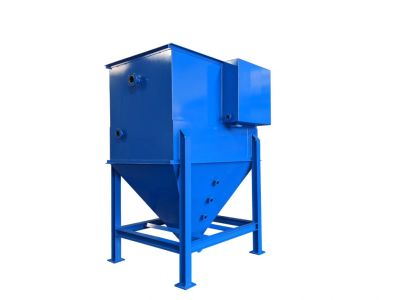
Plate Spacing Is Important
Inclined Plate Clarifier vs. Conventional Settling Tank
Inclined Plate Clarifier Retention Time
Adding more plates is not always the answer.
The space between inclined plates must remain large enough to allow wastewater, floc, and settled solids to move through the plate pack.
Extremely tight plate spacing may provide impressive theoretical surface area, but it can create operational problems when treating industrial sludge.
Industrial wastewater solids can include:
- Metal hydroxide floc
- Aluminum hydroxide
- Iron hydroxide
- Paint solids
- Mineral solids
- Machining solids
- Chemical precipitates
- Other suspended materials
Many of these solids can be bulky or sticky.
The plate pack therefore needs to balance available settling area with sufficient open space for reliable solids movement.
Met-Chem considers both hydraulic performance and the characteristics of the solids being treated when selecting a plate configuration.
Inclined Plate Clarifier Retention Time
Inclined Plate Clarifier vs. Conventional Settling Tank
Inclined Plate Clarifier Retention Time
Inclined plates can dramatically increase settling area, but plate area does not replace tank volume.
This is an important distinction in industrial wastewater treatment.
A clarifier can have substantial theoretical plate area while still having insufficient volume to handle changing flow rates, chemical reactions, floc formation, and sludge accumulation.
Met-Chem designs its standard industrial clarification systems with approximately 50–60 minutes of hydraulic retention time, depending on the system configuration.
Adequate retention time can help:
- Reduce hydraulic disturbances
- Accommodate changes in wastewater flow
- Allow additional floc development
- Improve settling consistency
- Provide sludge storage
- Reduce solids carryover
- Improve overall process stability
For industrial wastewater, Met-Chem believes both settling area and retention time should be considered when selecting a clarifier.
Inclined Plate Clarifier vs. Conventional Settling Tank
Inclined Plate Clarifier vs. Conventional Settling Tank
Inclined Plate Clarifier vs. Conventional Settling Tank
Both systems rely on gravity.
The primary difference is how settling area is provided.
A conventional settling tank typically relies on a large horizontal tank surface area.
An inclined plate clarifier places multiple settling surfaces inside the tank.
This allows the inclined plate design to provide more effective settling area within a smaller footprint.
Conventional Settling Tank
- Requires significant floor space
- Uses the tank's horizontal area for settling
- Particles may travel a greater settling distance
- Can be appropriate for very large flows or certain solids
Inclined Plate Clarifier
- Uses multiple inclined settling surfaces
- Provides high projected area within a compact footprint
- Reduces particle settling distance
- Can integrate flocculation and sludge collection
- Well suited for many industrial wastewater applications
The appropriate system depends on the wastewater and application.
Inclined Plate Clarifier vs. Lamella Clarifier
Chemical Treatment Before Inclined Plate Clarification
Inclined Plate Clarifier vs. Conventional Settling Tank
The terms inclined plate clarifier and lamella clarifier are commonly used to describe the same general clarification technology.
Both systems use multiple inclined settling surfaces to increase effective settling area.
Other terms commonly encountered include:
- Inclined Plate Settler
- Lamella Settler
- Parallel Plate Clarifier
- Plate Settler
- Slant Plate Clarifier
Met-Chem manufactures industrial clarifiers using inclined parallel plate technology.
Regardless of terminology, the important design considerations remain the same:
- Effective settling area
- Plate angle
- Plate spacing
- Hydraulic distribution
- Retention time
- Solids loading
- Sludge storage
- Sludge removal
- Wastewater chemistry
Chemical Treatment Before Inclined Plate Clarification
Chemical Treatment Before Inclined Plate Clarification
Chemical Treatment Before Inclined Plate Clarification
An inclined plate clarifier separates settleable suspended solids.
It does not automatically remove dissolved contaminants.
This distinction is especially important for industrial wastewater containing dissolved metals.
Chemical treatment may first be required to convert dissolved contaminants into insoluble particles.
A typical industrial treatment sequence might be:
Equalization → pH Adjustment → Chemical Precipitation → Coagulation → Flocculation → Inclined Plate Clarifier
Once the contaminants have been converted into suspended solids and properly flocculated, the inclined plate clarifier can separate them from the treated water.
Flocculation and Inclined Plate Settling
Chemical Treatment Before Inclined Plate Clarification
Chemical Treatment Before Inclined Plate Clarification
Very small particles do not always settle efficiently.
Coagulation and flocculation can improve clarification by combining smaller particles into larger, heavier floc.
Met-Chem inclined plate clarifiers can incorporate a flocculation section before the wastewater enters the settling plates.
Polymer can be introduced into this compartment while gentle mixing encourages particle contact and floc growth.
Proper floc should be large enough to settle effectively while remaining strong enough to move through the clarifier without immediately breaking apart.
Good chemical treatment can therefore be just as important as the physical clarifier design.
Hydraulic Distribution Through the Plate Pack
What Happens to Solids on the Inclined Plates?
What Happens to Solids on the Inclined Plates?
Wastewater must be distributed evenly across the available plate area.
If most of the wastewater travels through only one portion of the plate pack, that section can become hydraulically overloaded while other plates contribute very little to clarification.
Good clarifier design therefore attempts to distribute flow throughout the settling section.
The goal is relatively uniform upward velocity through the spaces between the plates.
Proper hydraulic distribution helps the entire plate pack contribute to solids separation.
What Happens to Solids on the Inclined Plates?
What Happens to Solids on the Inclined Plates?
What Happens to Solids on the Inclined Plates?
As suspended solids settle onto the plate surfaces, they begin accumulating.
Additional solids contact this material and form a heavier layer.
Because the plates are inclined, gravity pulls the accumulated solids downward.
The sludge travels down the plate surfaces and eventually falls from the bottom of the plate pack.
From there, the solids enter the sludge collection cone.
This continuous downward movement is why plate angle and plate condition are so important.
The plate pack should encourage solids to leave the settling section rather than permanently accumulating between the plates.
Inclined Plate Clarifier Sludge Cone
What Happens to Solids on the Inclined Plates?
Inclined Plate Clarifier Sludge Cone
The sludge cone provides storage for solids after they leave the inclined plates.
The cone geometry directs the sludge toward the discharge point at the bottom of the clarifier.
However, the sludge cone should not be treated as long-term sludge storage.
Allowing excessive solids to accumulate can eventually raise the sludge level toward the plate pack.
Met-Chem recommends regular sludge removal and can incorporate automatic sludge blowdown controls into the clarification system.
Removing smaller quantities of sludge frequently can provide more consistent operation than waiting for the cone to become completely full..
Automatic Sludge Removal
Where Does Inclined Plate Clarifier Sludge Go?
Inclined Plate Clarifier Sludge Cone
An inclined plate clarifier can operate continuously, but the solids it separates must be removed.
Met-Chem can provide automatic sludge blowdown using a timed control sequence.
Depending on the system, the controls can periodically open a sludge valve and operate the sludge transfer pump.
The proper frequency depends on:
- Wastewater flow
- Influent solids
- Chemical precipitation
- Sludge concentration
- Clarifier size
- Production schedule
During startup, operators can monitor sludge production and adjust the blowdown interval accordingly.
Where Does Inclined Plate Clarifier Sludge Go?
Where Does Inclined Plate Clarifier Sludge Go?
Where Does Inclined Plate Clarifier Sludge Go?
For many industrial wastewater systems, clarifier sludge is transferred to a sludge holding tank.
The holding tank provides storage between clarifier blowdown and sludge dewatering cycles.
A common Met-Chem process is:
Inclined Plate Clarifier → Sludge Holding Tank → Filter Press
The filter press removes additional water from the sludge and produces a dewatered filter cake.
This arrangement works well because the clarifier generally treats wastewater continuously while the filter press operates in batches.
Inclined Plate Clarifier + Filter Press
Where Does Inclined Plate Clarifier Sludge Go?
Where Does Inclined Plate Clarifier Sludge Go?
Combining an inclined plate clarifier with a filter press provides both wastewater clarification and sludge dewatering.
The inclined plate clarifier separates suspended solids from the main wastewater stream.
The filter press removes water from the concentrated sludge.
For example, a continuous industrial wastewater treatment system may send treated water through the clarifier throughout the production day.
The clarifier continuously concentrates the removed solids into its sludge stream.
That smaller sludge stream can then be stored and periodically pumped into the filter press.
The resulting filter cake can be handled for disposal while the filtrate can often be returned to the treatment system.

Met-Chem Inclined Plate Clarifier Sizes
Met-Chem manufactures inclined plate clarifiers for a wide range of industrial wastewater flow rates.
Common capacities include:
- 30 GPM
- 60 GPM
- 90 GPM
- 120 GPM
- 180 GPM
- 240 GPM
- 300 GPM
Larger and custom inclined plate clarifiers are also available.
Flow rate provides a useful starting point, but it should not be the only factor used to select a clarifier.
Met-Chem can evaluate wastewater characteristics, solids loading, settling behavior, treatment chemistry, and hydraulic requirements when sizing the system.
Inclined Plate Clarifier Construction
Inclined Plate Clarifier Construction
Inclined Plate Clarifier Construction
Met-Chem can manufacture industrial clarifiers using materials selected for the wastewater application.
Available configurations can include:
- Carbon steel tanks
- Stainless steel tanks
- Chemical-resistant construction options
- PVC inclined settling plates
- Integrated flocculation compartments
- Mixers
- Effluent weirs
- Sludge cones
- Automatic sludge valves
- Sludge pumps
- Control panels
The clarifier can be supplied as standalone equipment or incorporated into a larger Met-Chem wastewater treatment system.
Maintaining Inclined Clarifier Plates
Inclined Plate Clarifier Construction
Inclined Plate Clarifier Construction
The settling plates should be periodically inspected as part of routine clarifier maintenance.
Operators should look for:
- Excessive solids buildup
- Blocked flow channels
- Damaged plates
- Displaced plates
- Uneven flow
- Biological growth when applicable
- Chemical deposits or scale
A properly operating plate pack should provide open flow channels while allowing solids to move down the inclined surfaces.
If solids repeatedly accumulate within the plate pack, the cause should be investigated.
Possible causes include excessive solids loading, poor sludge removal, inadequate chemical treatment, inappropriate plate spacing, or hydraulic overloading.
Replacement Inclined Plate Packs
Inclined Plate Clarifier Construction
Benefits of Met-Chem Inclined Plate Clarifiers
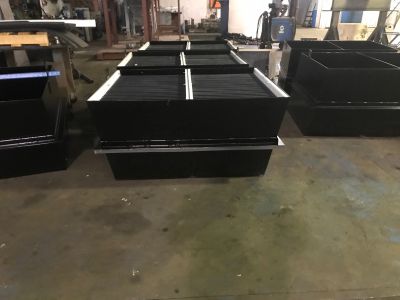
The settling tank itself can remain serviceable long after the original plate packs have become damaged, brittle, clogged, or otherwise unsuitable.
In these situations, replacing the plate packs may extend the useful life of the clarifier without replacing the entire system.
Met-Chem manufactures replacement inclined plate packs for industrial clarification applications.
Replacement packs can be evaluated based on:
- Existing tank dimensions
- Plate pack dimensions
- Required plate angle
- Plate spacing
- Wastewater chemistry
- Operating temperature
- Required settling area
- Flow rate
Measurements and photographs of the existing clarifier can help Met-Chem evaluate a replacement plate pack.
Benefits of Met-Chem Inclined Plate Clarifiers
Frequently Asked Questions About Inclined Plate Clarifiers
Benefits of Met-Chem Inclined Plate Clarifiers
A properly designed Met-Chem inclined plate clarifier can provide:
- Large effective settling area
- Compact equipment footprint
- Approximately 60-degree plate angle
- Short particle settling distance
- Approximately 50–60 minute retention time
- Integrated flocculation
- Automatic sludge blowdown
- Standard and custom capacities
- Replacement plate pack capability
- Integration with Met-Chem filter presses
- Complete industrial wastewater treatment capability
The objective is not simply to install as many plates as possible.
The plate pack, tank volume, hydraulic distribution, chemical treatment, sludge storage, and sludge removal system must work together.
Frequently Asked Questions About Inclined Plate Clarifiers
Frequently Asked Questions About Inclined Plate Clarifiers
Frequently Asked Questions About Inclined Plate Clarifiers
What is an inclined plate clarifier?
An inclined plate clarifier is a gravity separation device that uses multiple angled parallel plates to increase the effective settling area available for separating suspended solids from water.
How does an inclined plate clarifier work?
Wastewater flows upward between inclined plates while suspended solids settle onto the plate surfaces. The solids slide downward into a sludge collection cone while clarified water exits from the top of the clarifier.
Why are clarifier plates inclined?
Inclining the plates provides projected settling area while allowing accumulated solids to move downward under gravity.
What angle should inclined clarifier plates be?
Met-Chem commonly uses plates positioned at approximately 60 degrees from horizontal.
Is an inclined plate clarifier the same as a lamella clarifier?
The terms are commonly used interchangeably to describe clarification equipment that uses inclined settling surfaces.
How far apart should inclined clarifier plates be?
Plate spacing depends on the wastewater and solids being treated. The design must balance effective settling area with sufficient open space for wastewater, floc, and sludge movement.
Can inclined plate clarifiers remove dissolved metals?
Not directly. Dissolved metals generally must first be chemically precipitated into suspended solids. The resulting solids can then be separated by clarification.
How much retention time does an inclined plate clarifier need?
The required retention time depends on the application. Met-Chem's standard industrial clarification systems are typically designed with approximately 50–60 minutes of retention time, depending on configuration.
Can inclined plate packs be replaced?
Yes. Met-Chem can manufacture replacement inclined plate packs for existing industrial clarification systems.
How do you size an inclined plate clarifier?
Met-Chem Inclined Plate Clarifier Manufacturer
Frequently Asked Questions About Inclined Plate Clarifiers
Frequently Asked Questions About Inclined Plate Clarifiers
Met-Chem designs and manufactures inclined plate clarifiers, lamella clarifiers, replacement plate packs, filter presses, and complete industrial wastewater treatment systems.
We approach clarification as part of the complete wastewater treatment process.
Proper chemical precipitation must create settleable solids.
Flocculation must develop those solids into suitable floc.
The inclined plates must provide sufficient settling area.
The clarifier must provide adequate hydraulic volume and retention time.
And the accumulated sludge must be reliably removed and dewatered.
If you are evaluating an inclined plate clarifier, provide Met-Chem with:
- Average wastewater flow
- Peak wastewater flow
- Operating hours
- Wastewater source
- Suspended solids concentration
- Dissolved contaminants
- Wastewater analysis
- Existing chemical treatment
- Required discharge limits
- Available floor space
Met-Chem can use this information to help determine the appropriate clarification process and equipment size.
Contact Met-Chem for inclined plate clarifier sizing, pricing, replacement plate packs, or a complete industrial wastewater treatment system.
This website uses cookies.
We use cookies to analyze website traffic and optimize your website experience. By accepting our use of cookies, your data will be aggregated with all other user data.